Inspecting 50,000-file Delta Lake tables in 111ms and 89MB RAM without a JVM
How DeltaLens parses NDJSON commits, V2 Parquet checkpoints, sidecars, and Deletion Vectors from a single 13.8 MB binary, plus head-to-head cold and warm benchmarks against delta-rs.
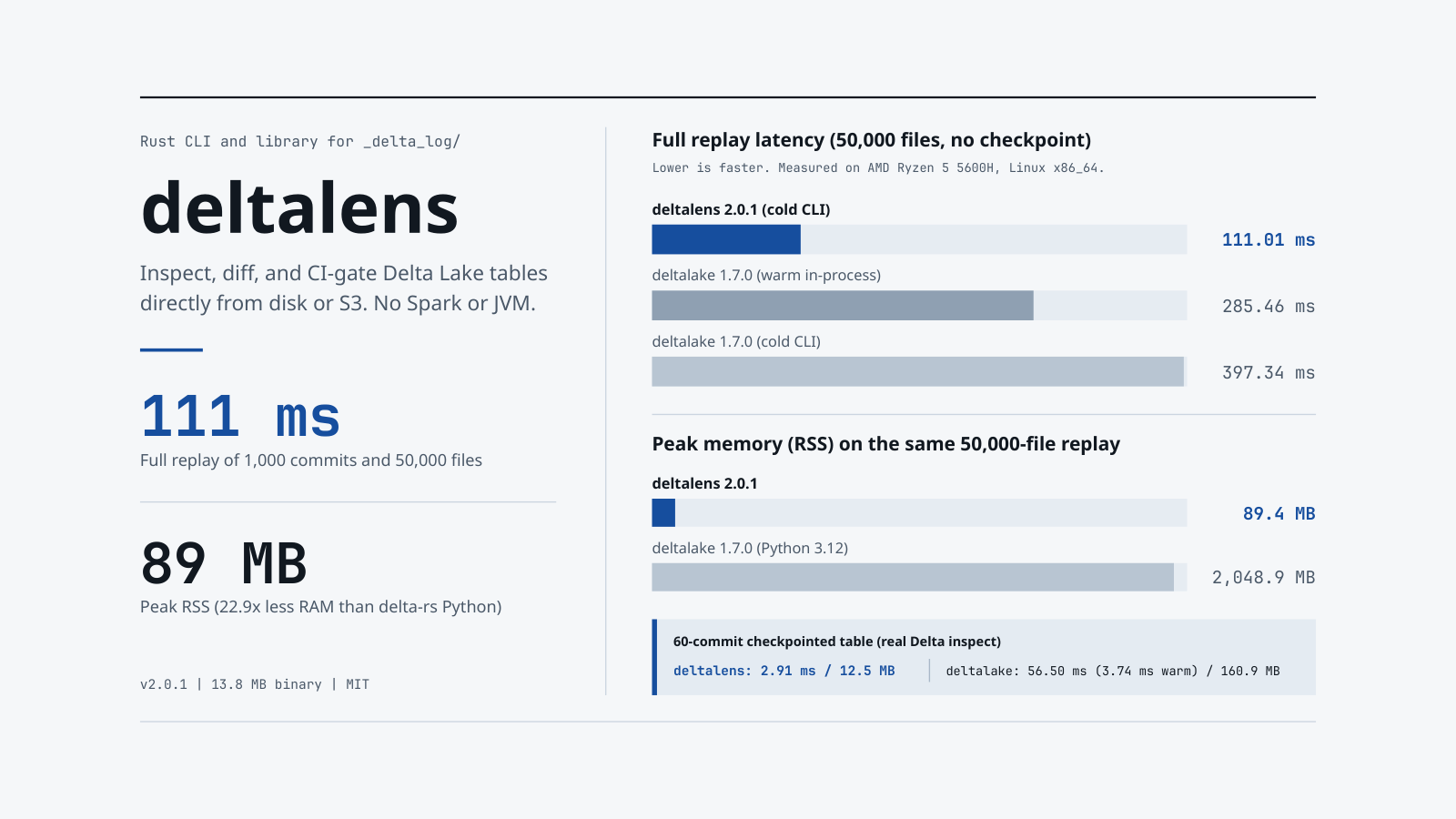
When a Delta Lake table slows down, the first four questions are almost always metadata questions. How many files sit under 32 MB? How skewed are the file sizes? How much dead data is waiting on VACUUM? Did last night's MERGE drop or narrow a column?
Answering those four questions usually costs 10 to 30 seconds of Spark startup, an active Databricks SQL warehouse, or a Python virtualenv carrying deltalake and pyarrow. None of those questions touch a single Parquet row. Every answer already lives inside _delta_log/.
I built DeltaLens (deltalens, 13.8 MB standalone Rust binary, MIT) to answer them directly from the terminal or CI without Spark, a JVM, or Python.
Head-to-head benchmarks (cold and warm)
CLI benchmarks often cheat by comparing a compiled binary against cold Python interpreter startup. To keep the comparison honest, scripts/bench_compare.py measures both cold CLI subprocesses and warm in-process calls in deltalake 1.7.0 (delta-rs Python 3.12.16) on Linux x86_64 (AMD Ryzen 5 5600H, 12 logical CPUs).
| Workload | deltalens (cold) | deltalake Py (cold) | deltalake Py (warm) | Peak RSS |
|---|---|---|---|---|
| Real 60-commit table (Parquet checkpoints, schema change, DELETE) inspect | 2.91 ms | 56.50 ms | 3.74 ms | 12.5 MB vs 160.9 MB |
| Real 60-commit table lineage (last 20) vs history(20) | 2.34 ms | 61.04 ms | 4.45 ms | 12.6 MB vs 221.6 MB |
| Real 60-commit table diff (v0 to v60) | 2.60 ms | n/a | n/a | 12.4 MB |
| 100 commits / 1,000 files (full replay, no checkpoint) | 4.24 ms | 90.72 ms | 16.81 ms | 12.7 MB vs 398.4 MB |
| 1,000 commits / 50,000 files (full replay, no checkpoint) | 111.01 ms | 397.34 ms | 285.46 ms | 89.4 MB vs 2,048.9 MB |
Run the exact script yourself with zero permanent Python installs:
git clone https://github.com/sandy-sachin7/deltalens.git
cd deltalens
cargo build --release --locked
uv run --with deltalake --with pyarrow python3 scripts/bench_compare.py
Four design choices behind the speed
1. Skip historical cloud listings with _last_checkpoint
On an S3 or ADLS table with 40,000 historical commits, a naive ListObjectsV2 call burns dozens of HTTP round trips before parsing starts. For inspect, schema, and diff, DeltaLens reads _delta_log/_last_checkpoint first. When the target version is at or after the checkpoint version V, it calls object_store::ObjectStore::list_with_offset starting at {V:020}. If the hint is missing, stale, or points to an incomplete multi-part checkpoint, it falls back to a cached single listing.
2. Keep Tokio for network I/O and Rayon for CPU parsing
Mixing async object-store reads with parallel CPU parsing often ends in nested Tokio runtimes or thread starvation. DeltaLens separates the two phases cleanly. Cloud backends fetch all needed bytes first through a shared process-wide Tokio runtime using futures::stream::buffer_unordered(32). Only after raw byte buffers are in memory does Rayon fan out to parse NDJSON commits and Arrow Parquet checkpoints in parallel.
3. Unified Remove-before-Add state machine
Delta operations like RESTORE and Deletion Vector updates emit both a remove and an add for the same physical Parquet path inside one commit. Keying active files by path alone drops live files or double-counts Deletion Vectors. DeltaLens keys live state by (percent_decoded_path, deletion_vector_unique_id) and runs Phase 1 (Remove) strictly before Phase 2 (Add) inside each commit. Tombstone retention parses delta.deletedFileRetentionDuration (defaulting to 7 days) so inspect reports exact reclaimable bytes.
4. Read-only contract and TOCTOU-free local containment
The StorageBackend trait defines only read, list, exists, and stat operations. On Linux and macOS, LocalStorage pins the table root via O_DIRECTORY | O_CLOEXEC and traverses every relative path component with openat(..., O_NOFOLLOW). V2 checkpoint _sidecars/ references and cloud keys reject .., backslashes, and prefix escapes.
What shipped in v2.1.0: conformance, fuzzing, and live S3 CI
Fast metadata replay only helps if the replay matches the Delta Lake specification on edge cases. Release v2.1.0 adds protocol checks and conformance suites on top of the v2.0.1 benchmarked core:
- Differential conformance against delta-rs. scripts/diff_test.py generates real tables with
deltalakeacross four scenarios (Parquet checkpoints, schema evolution, DELETE/UPDATE/MERGE/OPTIMIZE/VACUUM, nested column-mapped schemas, and Deletion Vectors) and checks every active file path, size, row count, and schema againstdeltalens inspect --json. - Fail-loudly reader protocol checks. Any table requiring
minReaderVersion > 3or an unsupportedreaderFeaturesentry (such ascatalogManaged) returnsDeltaLensError::UnsupportedProtocolinstead of silently misreading log state. - Spec-compliant typeWidening rules. Schema diffing now treats
datetotimestampas breaking, permitsdatetotimestamp_ntz, allows integer-to-double and bounded integer-to-decimal widenings (byte,short,integer,longtodecimal(p, s)with integral digits at least3,5,10, and19), and allows scale-preserving decimal widening. - Parser fuzzing and live S3 HTTP CI. Four
cargo-fuzztargets underfuzz/exercise NDJSON actions, schema JSON, table paths, and V2 sidecar parsing. Integration tests intests/cloud_s3.rsrun in GitHub Actions against an ephemeral Moto S3 HTTP server viascripts/run_s3_test.py.
What shipped in v2.2.0: Apache Spark DAT conformance and continuous fuzzing
Comparing against delta-rs alone leaves open whether a parser matches tables written by Apache Spark itself. Release v2.2.0 adds official Spark conformance tests, scheduled fuzzing in CI, and an opt-in live cloud workflow:
- Official Apache Spark DAT suite (
delta-incubator/dat v0.0.3). scripts/dat_test.py downloads the SHA-256 pinneddelta-incubator/dat v0.0.3release archive (19c045bc...) and validates all 19 Spark-written Delta tables across 29 expected snapshots (bothlatestand historical versionsv0,v1, andv2). All 19 tables and 29 snapshots pass in thespark-datGitHub Actions job on every push. - Continuous parser fuzzing in CI. Checked-in seed corpora under
fuzz/corpus/drive all four targets (commit_ndjson,last_checkpoint,parquet_checkpoint,schema_json) in .github/workflows/fuzz.yml on a weekly schedule, on parser pull requests, and on manual dispatch. - Opt-in live cloud check. .github/workflows/cloud-live.yml runs
deltalens inspectagainst live S3, GCS, or Azure ADLS buckets viaworkflow_dispatchwhen credentials are supplied.
Wiring it into CI in five lines
DeltaLens ships a composite GitHub Action with SHA-256 binary verification. Breaking schema changes (column removal, Column Mapping renames, narrowing type conversions, or tightened nullability) exit with code 2 and post a report to $GITHUB_STEP_SUMMARY.
- uses: sandy-sachin7/deltalens@main
  with:
    command: diff
    path: s3://my-bucket/warehouse/transactions
    args: --v1 ${{ env.PREV_VER }} --v2 ${{ env.CURR_VER }} --fail-on-breaking
Install v2.2.0 with cargo install deltalens (or --no-default-features for a pure-local build with zero HTTP dependencies).